




Description
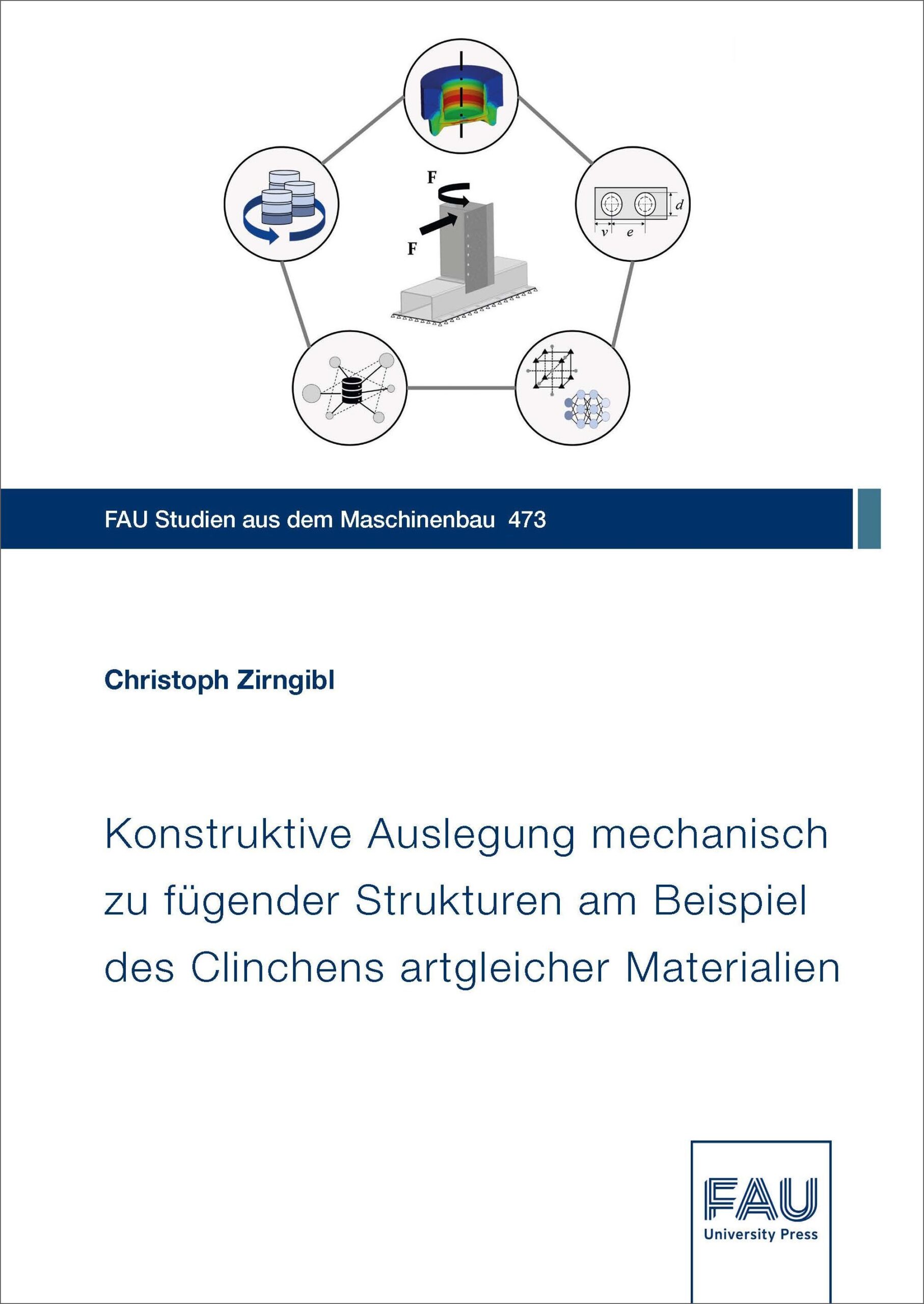
This thesis proposes a design framework for addressing challenges in developing advanced lightweight designs and multi-material structures using mechanical joining technologies. Since only limited standards and norms are available, the given approach combines knowledge-based and data-driven methods to support engineers during the product development process aiming to reduce time-and cost-intensive trial-and-error loops. Focusing on the early design phases, both joinability criteria and product requirements are equally considered for decision-making. Using the mechanical joining technology Clinching as an example, the framework integrates machine learning algorithms that predict relevant joint properties based on material-thickness-combinations, tool configurations, and process settings. In order to set-up these regression models the initial generation of training data relies on the numerical and parametrized representation of the Clinch joining process in the FEM simulation software LS-DYNA. Besides the determination of individual joints, the framework also analysis the impact of uncertain conditions such as tolerance-related tool variations on the robustness of the entire joining connection. Therefore, statistical methods and sensitivity analyses gain a deeper understanding of how relevant joint properties distribute and which process parameters are of high relevance. According to generate feasible product designs, the framework also considers production constraints and rules such as geometrical specifications regarding the positioning and amount of individual joints. In combination with parametrized CAD parts the engineer will be assisted in solving versatile joining tasks. Thus, the proposed framework paves the way towards a knowledge-based and data-driven design of advanced lightweight structures using mechanical joining technologies.
Reviews
There are no reviews yet.